Home / Instruments / Differential Scanning Calorimeter (DSC)
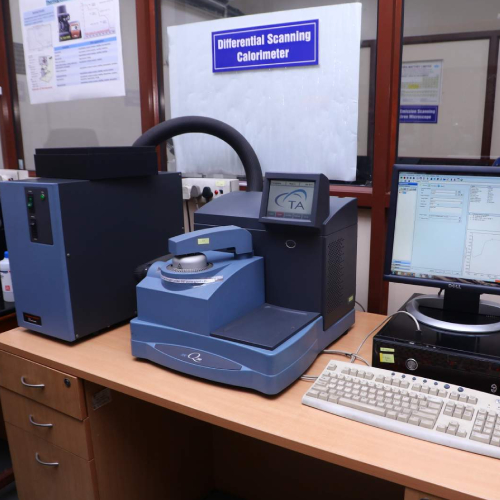
Differential Scanning Calorimeter (DSC)
You need a USIC account to book this instrument —
log in or
create a free account.
Requisition forms
Please download the requisition form, fill it in, sign it, and upload the filled copy with your booking. This requisition form is provided by the USIC office for this instrument.
Process: submit booking → in-charge approval → pay on the DU fee portal → upload Order ID + receipt → measurement confirmed. See the payment flowchart and user guidelines.
About this instrument
Model : Q200
Features/Specifications:
- Temperature Range:
- Standard Range: -80 °C to 400 °C
-
- Heating and Cooling Rates:
- Heating Rate: 1 °C/min to 20 °C/min
- Cooling Rate: °C/min to 20 °C/min
- Sensitivity:
- High Sensitivity: Capable of detecting minute thermal events (e.g., phase transitions) with exceptional precision.
- Heat Flow Sensitivity: 0.2 µW, allowing for the detection of low-enthalpy transitions.
- Heat Capacity Measurement:
- Provides accurate measurements of heat capacity (Cp) as a function of temperature.
- Atmosphere Control:
- Can operate under nitrogen atmospheres.
- Sample Holders and Crucibles:
- Sample holders made of aluminum, suited to the analysis of specific samples.
- Software:
- TA Universal Analysis™ Software: User-friendly software for data collection, analysis, and reporting.
- Real-time data display for temperature vs. heat flow (mW) plots.
- Advanced features for curve analysis, including integration, peak fitting, and transition identification.
- Capability to perform multi-sample and multi-step analysis.
- Data export functionality for easy sharing of results in various formats (e.g., CSV, Excel).
- Data Analysis and Reporting:
- Analysis of glass transition (Tg), melting point (Tm), crystallization temperature (Tc), specific heat capacity, and other thermal events.
- Thermal event interpretation and quantitative analysis.
- Cooling System (Optional):
- Cryogenic cooling option for low-temperature studies, down to -180 °C, typically with a liquid nitrogen cooling system.
- Sample Size:
- The sample size is typically between 1 mg and 20 mg (depending on the specific material and the sensitivity required for analysis).